Oct 7
Tugbenyoh wants troubled SF agency to be city’s ‘conscience’
John Ferrannini READ TIME: 6 MIN.
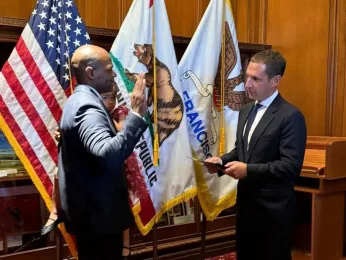
Mawuli Tugbenyoh, a gay man who’s the newly-permanent executive director of the San Francisco Human Rights Commission, wants to move forward after the agency was rocked by scandal. He had stepped into the role as acting head last October and was sworn in by Mayor Daniel Lurie September 22.
Lurie had permanently appointed Tugbenyoh, 43, to the position September 19. The immediate past co-chair of the Alice B. Toklas LGBTQ Democratic Club, Tugbenyoh had been deputy director in the San Francisco Department of Human Resources.
Cheryl Davis, the former head of the HRC, resigned in disgrace last year after it was revealed she signed off on $1.5 million in contracts with nonprofit Collective Impact, run by a man with whom she shared a home address and a car. Davis was required to disclose this and allegedly didn't. Further, a San Francisco Chronicle investigation also revealed alleged financial mismanagement at the city agency, reporting that people were overpaid tens of thousands of dollars, that expenses were approved without documentation, and that one nonprofit director received a reimbursement for a $10,000 Martha's Vineyard rental.
According to the Chronicle, Davis, through her attorney, has maintained that she tried to avoid conflicts of interest in her role and “never made any decisions to personally enrich herself and others at the expense of public resources.”
Tugbenyoh said in an October 6 phone interview with the Bay Area Reporter that he has been charged with returning the agency to its basics – investigating claims of discrimination in the city. The commission has a budget of $28 million for Fiscal Year 2025-2026, down 38% from the prior year.
“Our department exists to support communities and give voice to many people,” he said. “That function of our department has unfortunately taken a back seat in the last couple years and I want to make sure that work is at the forefront of everything that we do.”
The department receives about 2,000 discrimination complaints per year, and investigates a little under 100, Tugbenyoh said, adding he thinks there are many more that go unreported. Investigators from the civil rights division look into these complaints.
“Part of the goal I have in the next year is reintroducing the department to the residents of San Francisco so they can come to the human rights commission if they are experiencing discrimination,” Tugbenyoh said. “I spoke with the mayor and his staff, and I think they really are as interested as I am in getting back to the basics of the department. I’m looking forward to working with them on that and other executive initiatives, such as ensuring our grant management is one of the best in the city. That is my goal.”
Lurie is hopeful Tugbenyoh is just what the troubled agency needs.
“Throughout his nearly two decades of public service, Mawuli Tugbenyoh has made it his mission to advocate for all of San Francisco’s communities, especially those who have felt left behind by government,” Lurie stated. “As he takes on this role permanently, he will bring that experience working within city government and across communities to ensure that every dollar the city spends improves the lives of San Franciscans.”
So, too, is gay Board of Supervisors President Rafael Mandelman, who as District 8 supervisor represents the Castro district on the board.
"Mawuli is a dedicated public servant with decades of experience in government and community advocacy," Mandelman stated. "He has stepped up to lead the Human Rights Commission at a uniquely challenging time for the agency, and we are fortunate to have someone of his great talent and character in the role. I and my team look forward to continuing our work with Director Tugbenyoh."
The Chronicle reported that this summer Tugbenyoh thanked Davis – now under criminal investigation – while giving shout outs to people in the room who helped bring together an intern project for Black college students to come to San Francisco from around the country. The B.A.R. asked Tugbenyoh if he’d like to explain his choice to do that, and how he will rebuild trust in the department.
Tugbenyoh did not answer that first question but said that “rebuilding trust is a non-negotiable for me.”
“That’s a goal we are going to work to implement for as long as it takes,” he said. “What I’ll say is it’s going to be an ongoing process and one we’re committed to and we’re going to do that through action and not through talking.”
Asked for more specificity, Tugbenyoh said, “When it comes to our grantmaking, for instance, there were almost no structures in place to track our spending well, to track the impact that our dollars were having, and so we’ve put some systems in place there, in partnership with the controller’s office and the city administrator’s office and other city partners who have been doing this a lot longer than the human rights commission has; we put a lot of controls and tracking systems in place.”
Tugbenyoh is also overseeing a restructuring of the department – it is to be merged with the Department on the Status of Women into the Agency on Human Rights. Both departments are to keep their commissions. Tugbenyoh will be the head of the new agency.
Leah Pimentel, the chair of the Human Rights Commission, stated, “The commission is pleased to have Mawuli’s steady hand at the helm of the HRC. Over the last year, during his appointment as acting director, we have relied on him as a leader committed to the critical work of the department. We all look forward to continuing to benefit from his vision and thoughtful approach.”
The Department on the Status of Women has also had troubles recently with its former director, Kimberly Ellis, ousted after allegations she misspent city funds. Ellis didn’t immediately return a request for comment.
Commissioner Sophia Andary, a queer woman who serves on the Commission on the Status of Women, is worried that with the city looking to cut the number of commissions after voters passed Proposition E last November, her commission may be on the chopping block. Prop E calls for studying ways to modify or consolidate the city’s commissions. A proposed list of commissions is expected to go before voters in November 2026.
The commissions are being reviewed by the Commission Streamlining Task Force; the Commission on the Status of Women will be reviewed at an October 15 meeting in City Hall Room 263. Andary is recommending people who want to see it preserved in its current form make their voices heard by attending the hearing.
Andary warned that her understanding is that if the commission were made advisory, it could sunset in three years.
“At a time when women, girls, and gender-expansive people are still fighting for basic rights, bodily autonomy, equal pay, safety, and access to services, we need institutions specifically dedicated to advancing equity,” Andary suggests people say. “The Commission on the Status of Women plays a critical role in ensuring San Francisco lives up to its values of inclusion, transparency, and justice.”
Prior to the meeting, the streamlining task force released recommendations. As for the Commission on the Status of Women, it’s recommended the panel be kept – but the recommendations suggest it “could shift to an advisory role.”
“Anything that’s chartered they’re really not saying don’t keep it, their recommendation is to move them to advisory committees,” Andary said in a phone interview, speaking in a personal capacity and not as a member of the commission. “It removes any authority they have and, in my opinion, there's no point. It's just folks meeting and doesn’t give them any budget, appointment, hiring or firing authority, nothing of that sort.”
Andary suggested people “show up on the 15th.”
“We’d love for people to show up in person,” Andary said. “The other way to show up is go online and there’s a link to join the meeting.”
Tugbenyoh said, “During the budget process we had to make tough decisions and especially considering that we have merged with the [Department] on the Status of Women, we are trying to merge our work sites into as few as possible.”
The worksite merger will involve the Office of Transgender Initiatives, which currently works in the San Francisco LGBT Community Center but is expected to vacate those offices at the end of the year.
“It’s been incredible and I’ve really enjoyed working more closely with Director Honey Mahogany,” Tugbenyoh said, referring to the Office of Transgender Initiatives. “They do incredibly hard work, which is, given the times we’re living in, very important work and critical work, so it has been a pleasure working with them.”
Mahogany didn’t immediately return a request for comment.
Tugbenyoh hopes during his tenure, the Human Rights Commission will return to being the “conscience of the city.”
Trans commissioner appointed
Monroe Lace, a trans woman who teaches social studies in the San Francisco Unified School District and who in 2023 became the first trans woman to be crowned Miss San Francisco in the state’s 99-year history of the competition, was appointed by Lurie to the Human Rights Commission, according to an August 29 news release touting several appointments across city oversight panels.
“These appointees are experts in their fields and will bring a critical perspective to the commissions they serve – helping us build a safer, stronger, and more vibrant San Francisco,” Lurie stated. “I look forward to working with each of them to support San Francisco’s communities and deliver safe and clean streets to drive our city’s comeback.”
The commission could not make Lace available for an interview by press time.