Sep 30
New SFPD Mission Station captain hopes to stick around
John Ferrannini READ TIME: 6 MIN.
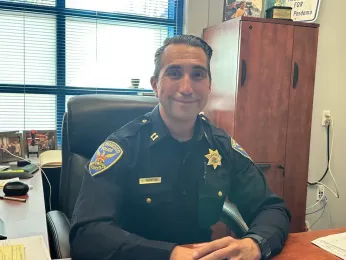
After about two months at the helm of Mission Station – the police precinct that oversees much of the Castro neighborhood – San Francisco Police Department Captain Sean Perdomo said it wasn’t hard to identify the biggest policing issue for the city’s LGBTQ neighborhood.
“That’s an easy one,” Perdomo, a 43-year-old San Francisco native and straight ally, said after having been asked that question in a sit-down interview at the station September 23. “Quality of life for sure, because fortunately we do not see a lot of violent crime in comparison to the rest of the district west of Guerrero [Street]. … It’s a citywide problem, not as publicized as what you see on Sixth Street, or here at 16th and Mission [streets].”
As the Bay Area Reporter previously reported, former police chief William Scott beefed up law enforcement in the Castro after gay Board of Supervisors President Rafael Mandelman, who represents the neighborhood on the board as District 8 supervisor, complained that efforts to improve street conditions downtown led to some people with violent tendencies to relocate to the streets of the Castro. Mandelman told the B.A.R. at the time that Lurie promised “more officers, more foot beats, more drug enforcement, more motorcycle cops – more of everything.”
Mandelman did not respond to a request for comment.
Asked if the additional officers are working, Perdomo said, “I believe so.”
Asked if there are metrics to measure if that’s the case, he said it’s hard to objectively measure that, but that his general sense from interactions with Castro residents is that things are improving. Perdomo is looking for the pattern “behind the numbers,” he said.
“When you look at the quantity of reports, I look more about qualitative,” Perdomo said. “Numbers fluctuate. Today’s warm; I can tell you for sure there will be more calls for service.”
Perdomo said District 8 Public Safety liaison Dave Burke, a straight ally, has a “list of individuals” whom Castro businesses, residents, and visitors have repeatedly complained about having caused disturbances. He called these “frequent flyers.”
Reached for comment, Burke stated that, "I hesitate to roll out this word because it is so overused these days – but Captain Perdomo is truly 'collaborative' with the community he serves.
"He's also smart, curious and a joy to work with," he stated of Perdomo. "The captain relishes taking questions from groups of Mission neighbors focused on the myriad issues involving public safety. In my experience, that's the best way to learn what people need, want and expect from the police."
Perdomo said, “We are doing criminal history checks and pulling their police reports, so if we have ongoing violence … then we can take criminal action."
Terry Asten Bennett, a straight ally who is the former president of the Castro Merchants Association and the co-owner of Cliff’s Variety at 479 Castro Street, told the B.A.R. that she has had “very positive” interactions with Perdomo.
“I love that we have a captain at Mission Station that already knows the neighborhood,” Asten Bennett stated to the B.A.R. “Every neighborhood has its challenges, but the Castro requires that the police understand our challenges, listen to us, and work with us to continue improving. I think coming into the job with this already understood has given him a head start.”
She said that in responding to calls for service, “he listened and he acted … in a productive manner.”
Perdomo said this is his third go-around at Mission Station, having been assigned there in the 2000s and in the 2010s, first as an officer and then as a sergeant. For this stint, he replaced Liza Johansen, a straight ally, as the captain after her abrupt departure.
Johansen had just started as the captain last fall, as the B.A.R. reported https://www.ebar.com/story/76760 at the time. She was the fifth Mission Station captain in four years responsible for the station.
Asked how long he intends to stay, Perdomo said, “I hope to be here as long as the chief will have me.”
A spokesperson for San Francisco interim Police Chief Paul Yep, who has replaced Scott as the city looks for a permanent chief, didn’t return a request for comment for this report.
Between Johansen’s tenure and Perdomo’s start on the job, Mission Station was led temporarily by Manny Bonilla.
A KPIX-TV report from February 2024 stated that Perdomo had been assisting with training a large new class of officers at the police academy. He formally was captain of the Police Academy and is a former treasurer of the San Francisco Police Officers Association.
Two years ago, Perdomo was involved in the department’s creating guidance on police foot chases. As he told the city’s Police Commission, “Something that you learn, as you become a more senior officer, is weighing the costs and benefits of chasing after somebody.”
A 2017 report in the San Francisco Examiner called him a “top scorer” in the officer exam. It stated he was “a sergeant with a record of aggressive policing, according to news reports and department sources. For instance, a man was acquitted in a case that involved Perdomo tackling him and falsely identifying him as a suspect in a drug-dealing case. But Perdomo is also known for putting away a man who was posing as a police officer and sexually assaulting Latino men.”
Other Castro stakeholders shared positive views of Perdomo’s tenure thus far.
Nate Bourg, a gay man who is the current president of the Castro Merchants, stated, “It's been a pleasure getting to know Captain Perdomo in his time so far as captain in what we hope will be a long tenure. The strong ongoing relationship between Castro Merchants and SFPD Mission Station is vital in helping keep our neighborhood safe and welcoming for residents, visitors and business owners.”
Andrea Aiello, a lesbian who is the executive director of the Castro Community Benefit District, also has a close working relationship with the SFPD. Aiello said Perdomo is leading with curiosity – and hopes he can stay longer than his recent predecessors.
“I have spoken with Captain Perdomo a few times and have found him welcoming, engaging, and competent,” Aiello stated. “He appears to have a fairly open door policy and is interested in getting to know the Castro, understand its challenges, and willing to dig into his toolbox to address those challenges that fall under his jurisdiction. I look forward to working with him and do hope he can stay at Mission Station for a few years.”
Perdomo promises officers will take reports
In the aftermath of a B.A.R. article featuring a gay man who alleged police discouraged him from reporting an alleged homophobic attack, Perdomo was asked if the perception San Francisco police are indifferent to crime is a public relations problem, or if his officers are not taking reports when they should be.
“I think it’s just poor public relations in the sense we haven’t explained what goes into a call for service and what goes into the officer’s response,” he said. “A lot of people don’t know why police do what they do. It’s very apparent to police officers, but not to the public.”
Perdomo said taking reports is “a game of telephone – literally,” and that sometimes (though not in the case of the person in the B.A.R.’s report) people call 911 but don’t want to provide police the necessary information to file a report.
“If police can’t develop a case or a suspect, they aren’t left with much else to do,” he said.
Perdomo assured the B.A.R. he would talk to any officer who didn’t take a crime report when they should.
“They will take a police report,” he said. “If they don’t do that, I will talk to them, open an investigation, and there will be discipline.”
Perdomo also had thoughts about Scott’s assertion to the B.A.R. earlier this year that data backed up the department’s decision to have officers walking the Castro beat during the day and not at night. Scott had said SFPD had “researched” the best times for officers to be walking the beat.
“The waking hours most people are out … even in the Castro, where there’s a thriving nightlife, the daytime, is the swing watch hours of noon to 8 [p.m.], 11 [a.m. to 7 [p.m.], those are the hours when most people are out,” Scott had said.
Perdomo said that, “It’s not uncommon where you have a lot of bars and alcohol” that there are nighttime safety issues.
“They say nothing good happens after midnight,” he quipped, but added, “I guess you don’t have a lot of complaints” about crime at the bars.
“You don’t see a lot of assault with a deadly weapon cases in places like that,” he said. “I just don’t get a lot of calls for service about nightlife stuff. If I did, I would shift more resources around to do that.”
Updated, 10/1/25: This article has been updated with comments from Dave Burke.